Ten Thousand xkcd.com/1053/
That said, watching the US President have dozens of these moments as he tried to come up to speed was not the kind of exciting I enjoy.
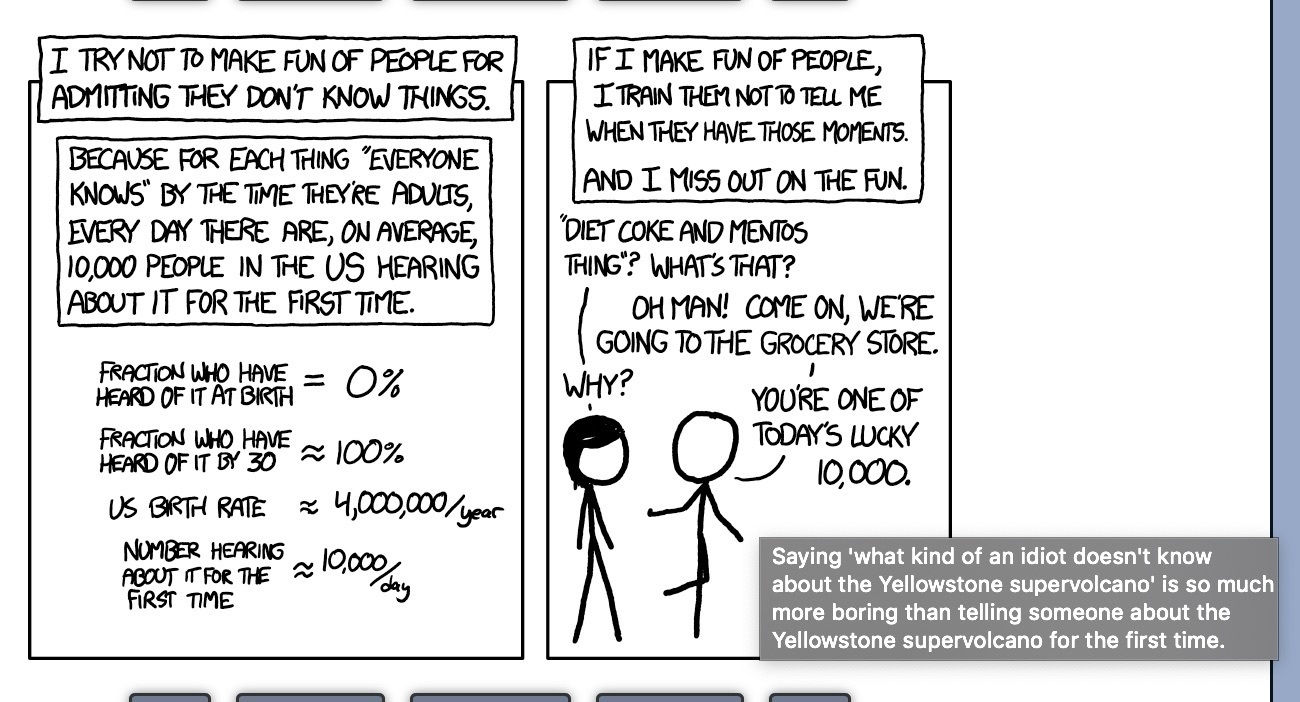
Ten Thousand xkcd.com/1053/
That said, watching the US President have dozens of these moments as he tried to come up to speed was not the kind of exciting I enjoy.
Sometimes in the evening, I return to do some work. But it’s late and hard to focus. I begin to #concentrate, and discover I have tried to read the internet.
🖊🗓#mbnov
Base Rates
www.smbc-comics.com/comic/ris…
HTT @rplzzz
🗓🖋#mbnov
‘’Once upon a planet dreary / Came a rocket engine cheery / On a flight to test a theory / On Mars’s frigid desert floor!
‘’Did life arise spontaneous / Or … / Seed the globe that now contains us? / Quoth the Lander, ‘Either-or.’ ‘’
~John A. Carroll 1977
This got my attention both because of its current echoes and because he’s right - I’ve forgotten it:
In this “moral panic” of thirty years ago, social workers and, later, prosecutors elicited from children horrific tales of Satan-worship, sexual abuse, and murder — and then, when anyone expressed skepticism, cried “We believe the children!” But every single one of the stories was false. … Moreover — and this is the point that I can’t stop thinking about — *the entire episode has been erased from our cultural memory. *
It pairs well with If Then, his reflection on reading the book of the same name.
When we, day by day and hour by hour, turn a direhose of distortion and misinformation directly into our own faces, we lose the ability to make measured judgments. We lash out against those we perceive to be our enemies and celebrate with an equally unreasonable passion those we deem to be our allies. … But there is another and still simpler problem with our presentism: we have no idea whether we have been through anything like what we are currently going through.
At this point he references his earlier post.
But only then does he begin to engage with If Then, where he points out that the current hope, hype, and fear of algorithms and technorati started 50 years ago with the Simulmatics corporation.
Which we’ve also forgotten.
l’ve seen some of the bizarre papers described in Maddie Blender’s article in Vice. Given their stream-of-consciousness technobabble, I thought they were generated by neural nets – I’ve gotten a couple of those during conference review, and read published papers describing automated paper-writers – but it appears there really is a bunch of circle-squarers who write and possible believe this stuff.
Most of it isn’t even fringe. It’s just BS - verbiage and ideas without regard for the idea of truth.
the bullshitter doesn’t care if what they say is true or false, but rather only cares whether their lister is persuaded.
As Pauli said, “not even wrong".
Dorothy Bishop, The Paper-in-a-Day Approach describes a once-a-year exercise her lab does to do a project in a mostly single intense session. Some key points:
When the Hubble Space Telescope allocation team launched dual-anonymous peer review for Hubble telescope time, the demographics of successful Principal Investigators (PIs) changed:
increasing the fraction of successful women PIs (such that the percentage of successful women PIs came within a point or two of successful male PIs), but also increasing the fraction of first-time PIs, suggesting that not only was there a historical gender bias but also a seniority bias.
Betteridge’s law of headlines:
“Any headline that ends in a question mark can be answered by the word no.”
Good summary by Jeremy Fox of Alvaro’s post, with a (closed) poll, & comments, including an excellent one by @repliCATS' Tim Parker.
Fox has written about replication before: here and elsewhere.
Suppose one reads a story of filthy atrocities in the paper. Then suppose that something turns up suggesting that the story might not be quite true, or not quite so bad as it was made out. Is one’s first feeling, ‘Thank God, even they aren’t quite so bad as that,’ or is it a feeling of disappointment, and even a determination to cling to the first story for the sheer pleasure of thinking your enemies are as bad as possible? If it is the second then it is, I am afraid, the first step in a process which, if followed to the end, will make us into devils. You see, one is beginning to wish that black was a little blacker. If we give that wish its head, later on we shall wish to see grey as black, and then to see white itself as black. Finally we shall insist on seeing everything – God and our friends and ourselves included – as bad, and not be able to stop doing it: we shall be fixed for ever in a universe of pure hatred.
Quote from Mere Christianity. Goodreads
Listening to Burnout discussion by authors Emily Nagoski and Amelia Nagoski on Brené Brown. 📚💬
In short, emotions are tunnels. If you go all the way through them you get to the light at the end. Exhaustion happens when we get stuck in an emotion.
Explores the idea of “completing the stress response cycle”. Hm!
From his essay We Are All Algorithms Now. Don’t get your news from social media.
For Facebook and Google and Instagram and Twitter, the business goal quickly became maximizing and monetizing human attention via addictive dopamine hits. Attention, they meticulously found, is correlated with emotional intensity, outrage, shock and provocation. Give artificial intelligence this simple knowledge about what distracts and compels humans, let the algorithms do their work, and the profits snowball. The cumulative effect — and it’s always in the same incendiary direction — is mass detachment from reality, and immersion in tribal fever.
…
Alternative views, unpleasant facts, discomforting arguments, contextualizing statistics, are, with ever-greater efficiency, filtered out of what our eyes can see and our minds absorb. And what we therefore believe becomes more fixed, axiomatic, self-reinforcing, and self-affirming. We become siloed into two affective tribes, with dehumanization of each other deepening with every news cycle. And we know what happens when dehumanization through social media is fully exploited. Ask the Rohingya of Burma, whose horrifying persecution was a function almost entirely of a Facebook disinformation campaign, seeded by a few in government and then unleashed by the masses in a spasm of genocidal violence.
A refreshing disclaimer from yesterday’s BMJ: Covid-19’s known unknowns
Competing interests: We have read and understood BMJ policy on declaration of interests and declare that all three authors have been wrong about covid-19. MM and MB initially believed substantial undocumented transmission meant that a large proportion of the UK population was infected during the first wave. Subsequent seroprevalence surveys indicated that this was not the case. GDS thought that SARS-CoV-2 would be amplified through children and substantial mortality displacement would be observed. Neither has been the case.
HTT: @ReplicationWatch
Linda Fallacy?
QUESTION 2:
Should an automobile or pickup truck that is owned and used primarily by or for a veteran….
Are pickup trucks no longer automobiles? Or is veterans+pickups more salient?
Vox’s Kelsey Piper discusses the replication crisis in “Future Perfect" this week, elaborating on Alvaro de Menard’s (probably a nom-de-blog) recent post What’s wrong with social science and how to fix it…, in the context of other Vox coverage of replication and science.
It’s a good piece. If you’ve read Menard you won’t learn a lot, but it’s got the Vox flair and reaches a wider audience. It also adds some more context, including previous Vox articles.
The problem (summarizing Menard):
If scientists are pretty good at predicting whether a paper replicates, how can it be the case that they are as likely to cite a bad paper as a good one? Menard theorizes that many scientists don’t thoroughly check — or even read — papers once published, expecting that if they’re peer-reviewed, they’re fine. Bad papers are published by a peer-review process that is not adequate to catch them — and once they’re published, they are not penalized for being bad papers.
The problem (from a 2016 Vox piece):
We heard back from 270 scientists all over the world, including graduate students, senior professors, laboratory heads, and Fields Medalists. They told us that, in a variety of ways, their careers are being hijacked by perverse incentives. The result is bad science.
The real problem is the culture of science.
Ode to our forecasters: What a Year! 54K surveys, 42K trades, 3K claims; Dedicated ‘casters, belief shift from priors, SSR looks sound. Replications TBD, but crosscheck hints good accuracy.
@replicationmarkets #openscience #reproducibility #replication
I reviewed the Watanabe manuscript. I think it’s worth a follow-up. Am I missing something? #reproducibility #openscience #epitwitter
This sounds fantastic. Why haven’t I done this?
Karl Popper on Social Media
As for Adler, I was much impressed by a personal experience. Once, in 1919, 1 reported to him a case which to me did not seem particularly Adlerian, but which he found no difficulty in analysing in terms of his theory of inferiority feelings, although he had not even seen the child. Slightly shocked, I asked him how he could be so sure. “Because of my thousandfold experience,” he replied; whereupon I could not help saying: “And with this new case, I suppose, your experience has become thousand-and-one-fold.”
~ “Conjectures and Refutations”
Saturn. First attempt, just holding my iphone near the eyepiece and clicking photos until one finally aligned.

Science is getting harder to read. More jargon, more acronyms, worse writing. All those reduce citations.
79% of acronyms are used fewer than 10 times, ever. So cut back.
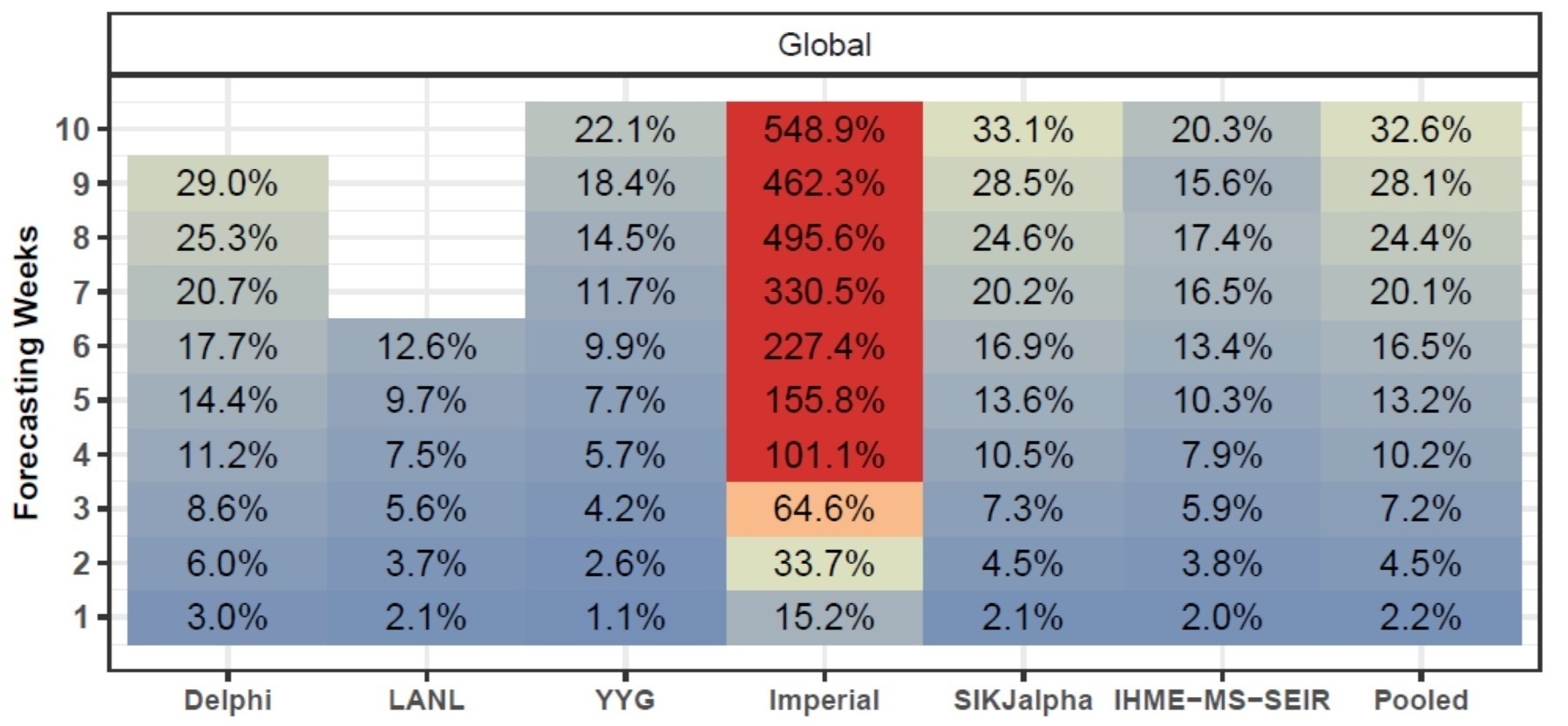
New PDF compares accuracy of 7 key #COVID-19 models. On mean absolute % error for total deaths (shown), YYG and IHME’s Mortality Spline (both w/SEIR) did well; Imperial’s SEIR way overestimated. On predicted peak timing, IHME’s simple Curve Fit won - huh. See paper for caveats.
Of the various kinds of misinformation during this pandemic, at least I was spared relatives touting the cow urine cure.
Piece in Meedan on coronavirus misinfo in India.
Short well-written plea to actually read the article.
I’ve been trying Readup, which is like a small community that can’t comment unless they use Safari’s Reader-mode and finish the article.