Fantastic Anachronism Q1 2021
I continue to be astonished by how much “Alvaro de Menard” reads. See his Q1 2021 links & reading summary.
I was going to write more, but finding this draft two months later, I think I’ll just post.
I continue to be astonished by how much “Alvaro de Menard” reads. See his Q1 2021 links & reading summary.
I was going to write more, but finding this draft two months later, I think I’ll just post.
A big reason spelling systems never seem to get overhauled in more liberal societies is that those in a position to change the rules have learned the old ones. Put another way, the type of folk who were once good at spelling bees now run the world.
Neither are face-recognition systems or sentencing software bought by those who suffer because of their failures.
In this letter, Heidi Larson & David Broniatowski argue that,
vaccine hesitancy is not the same as being “anti-vaccine.”
And that conflating the two risks driving the hesitant towards the fringe. Before exploring that, pause to admire the term Emotional Epidemiology which they [adopt from physician Danielle Ofri.]
Anti-vaxx typically shifts goalposts, embraces other conspiracy theories, and pushes explicit agendas. (To say nothing of deliberate disinfo, or shifting among mutually inconsistent theories.)
But vaccine hesitancy is diverse, including:
For example, you can be pro-vaxx and know that the replication crisis ⋅ probably ⋅ affects ⋅ big ⋅ clinical ⋅ trials, so you want to be sure about any particular new vaccine. Especially, say, one that set world speed records from research to production.
In this case after enough time without obvious problems, or a properly done study, a trusted person being convinced, or simply an increased risk of pandemic death, you’ll decide it’s safe enough. You may even be able to state those conditions ahead of time.
Finally, there’s the decision theorists who rationally decide to vaccinate only if others don’t. This is a moral problem of collective action, not a failure to understand. It’s why there are often laws about such things.
I have lost more time than I care to admit watching the volcano in Geldingsadalur. It’s fascinating.
~ ~ ~
SMBC summarizes _Science Fictions_. And as usual, [Meehl knew we were in trouble](https://citeseerx.ist.psu.edu/viewdoc/download?doi=10.1.1.392.6447&rep=rep1&type=pdf).~ ~ ~
Sen. Ben Sasse (R-Nebraska) [grasps the situation](https://www.theatlantic.com/ideas/archive/2021/01/conspiracy-theories-will-doom-republican-party/617707/). He notes similar problems on the Left, but focuses on his own party. A model for us all.~ ~ ~
Tipsy Teetotaler [catalogs some GOP craziness](https://intellectualoid.com/2021/01/29/antipopes-jackasses-jennyasses-and-more/).~ ~ ~
Also, I spend too much of Monday evenings on the internet.
I’m sorry to say I found this reflection by Adam Briggle almost entirely uninteresting. Of course we feel the absence of our tools. Is there really any philosophy to be done there?
In biographies and brands, after some clear examples Jacobs notes that many accusations of “factual errors” are really brand defenses:
When they said that Jacobs makes many factual errors, they weren’t even really making a truth claim, they were uttering a spell to ward off the stranger. They were placing me outside their Inner Ring.
~ ~ ~
In vendoring culture, I’m fascinated by the parallels he draws between vendoring code, and what Gene Luen Yang has done by incorporating DC Comics' earliest racist caricature into a new comic:
What Yang has done is moral repair through vendoring code &em; in this case ... cultural code. And note that Yang has not ... simply pointed to code created and maintained by someone else. ...he could only correct it by making it his own.
Had I read both, I still wouldn’t have made that connection. Spark.
~ ~ ~
MacWright:Frictionless note-taking produces notes, but it doesn’t - for me - produce memory.
HTT Nuño Sempere’s January forecasting newsletter. And be sure to check out his marvelous Metaforecast service!
~ ~ ~
So: Metacululs and RootClaim give very different probabilities that COVID-19 originated in a lab (see earlier post summarizing Monk):
Metaculus has ~3K forecasts on that question over the last year+, and over 260 comments, most well-informed. They’ve done well in COVID-19 forecasts vs. experts. (And famously one of their top forecasters nailed the pandemic in late January 2020, as Sempere reminds us.)
Rootclaim, as far as I can tell, begins with some crowdsourcing to formulate hypotheses, get initial probabilities, gather sources, and maybe to help set likelihoods. Then they do a Bayesian update. At one point they used full Bayesian networks. It seems this one treats each evidence-group as independent.
Both are heavily rationalist and Bayesian-friendly, and had access to each other’s forecasts. So the divergence is quite interesting - I wish I had time to dig into it some more.
The Excel row-limit inadvertently prevented contact tracing for two weeks in the UK, causing a natural experiment. Using outcome data the team estimated the gap caused 125,000 extra SARS-COV-2 cases and 1,500 COVID-19 deaths. Ouch.
Killing the SAT Means Hurting Minorities
While I’m thinking of Sullivan, this from his newsletter, regarding a conversation on his podcast:
When you regard debate itself as a form of white supremacy, you tend not to be very good at it.
FollowTheArgument on Inferring Political Orientation From a Single Picture reviews a recent paper showing algorithms can do this an astonishing 70% of the time, beating humans (55%) and a 100-item personality inventory (66%).
It’s still possible it’s latched onto some irrelevant or fragile feature set, but (a) they cropped close to the face, (b) they controlled for age/sex/race, (c) they cross-validated, and (d) they tested models from facebook on photos from other sites, and verce visa. Given the 2,048 features extracted by the facial image classifier, even regression did as well.
It seems ~60% is easily-named transient features like head-tilt, facial expression, etc. Leaving the rest as-yet-unnamed.
It’s tempting to go to physiognomy, but consider the following things humans do specifically to signal their affiliations:
What’s fascinating is how poorly humans do. But then, that result might be very different if the subjects were trained cold-readers.
FTA also covers Scott Alexander’s Modes Proposal. Good read.
I’ve been musing about all the Seussing. Social media discussions, and reading the spectrum on Flip Side (recommended).
I’m not especially qualified, but it seems to me:
Worth remembering:
“Among the people I work with in medical schools, there’s a strong adherence to what they call the health-literacy model, which is that physicians really believe that if you tell people the right information they will make decisions for themselves you yourself would make. And that’s an incorrect assumption.”
Despite the title, I found the article reassuring.
Key quotes from this post:
Snell:
incompatibility comes for every abandoned app eventually
Rendle:
on the web we don’t really own any space, we’re just borrowing land temporarily.
Jacobs:
My data I own, my internet presence I rent.But,
it’s quite likely that I will outlive all my work, and I’m just fine with that. So I’ll write in venues that give me pleasure,
Worth reading in entirety, Alan Jacobs reflects on an essay by Douthat:
Such a system, predictably, was terrible at generating the kind of outward-facing, evangelistic conservatives who had made the Reagan revolution possible.
He ends by saying Antonin Scalia was the sole survivor of the Old Republic, making Amy Coney Barret the Last Jedi.
(OK, Douthat doesn’t use Star Wars. But Sunstein did. I just blended them.)
Where Douthat muses on Trump’s loss, Ian Leslie reflected on Biden’s victory over both Sanders and Trump:
It's worth spending a bit of time on what it means to be moderate.Three forgotten principles of moderate politics that sparkle because they are both obvious and ignored.
Turns out Leslie has a new book, Conflicted:
Disagreement is the best way of thinking we have. It weeds out weak arguments, improves decision-making, leads to new ideas, and, counter-intuitively, brings us closer to one another. But only if we do it well - and right now, we’re doing it terribly.
Looking forward to it. Mercier & Sperber demonstrated that disagreement is how groups think, and that under the right conditions, they vastly outthink people.
For some gentle advice on How to Think, try Alan Jacobs' book by that name. We all cover the philosophy & cognitive science. Jacobs tackles the human component:
[We describe] argument as war ... because in many arguments there truly is something to be lost, and most often what's under threat is social affiliation. [My bold.]
What to do?
6. Gravitate, as best you can, in every way you can, toward people who seem to value genuine community and can handle disagreement with equanimity.
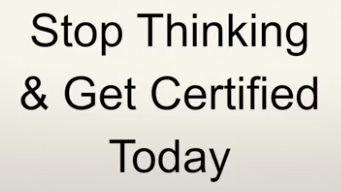
Slogan on an ad for scrum training. Featured in the the 2015 talk “Agile is Dead”.
Dave Thomas shows what goes wrong when “Agile” becomes a proper noun, and talks about reclaiming agility.
Find out where you are.
Take a small step towards your goal.
Adjust your understanding based on what you learned.
Repeat.
[All things equal], take the path that makes future change easier.
Gelman’s recent short post on Relevance of Bad Science for Good Science includes a handy Top10 junk list:
A Ted talkin’ sleep researcher misrepresenting the literature or just plain making things up; a controversial sociologist drawing sexist conclusions from surveys of N=3000 where N=300,000 would be needed; a disgraced primatologist who wouldn’t share his data; a celebrity researcher in eating behavior who published purportedly empirical papers corresponding to no possible empirical data; an Excel error that may have influenced national economic policy; an iffy study that claimed to find that North Korea was more democratic than North Carolina; a claim, unsupported by data, that subliminal smiley faces could massively shift attitudes on immigration; various noise-shuffling statistical methods that just won’t go away—all of these, and more, represent different extremes of junk science.
And the following sobering reminder why we study failures:
None of us do all these things, and many of us try to do none of these things—but I think that most of us do some of these things much of the time.
January 6 moved Randy Pherson at Globalytica to ask if there is an active insurrectionist movement in the US.
Before clicking, at least quickly decide whether you would rate these as High, Medium, or Low (image from his post):
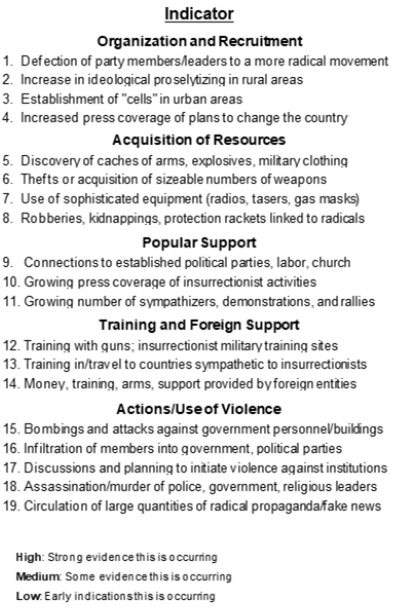
Then click to see ratings from a dozen of Pherson’s colleagues - probably professional or retired analysts.
Just re-found this @ayjay essay in an old tab.
The question I would ask churches that are re-opening without masks or distancing, but with lots of congregational singing, is: How do you think infectious disease works, exactly? How do you think COVID–19 is transmitted? What’s the theory you’re operating on?
I still know people using an incoherent mix of, well, all of these:

Writing for IEEE Spectrum, Joanna Goodrich says that Deep Blue beat Kasparov because was just so fast.
The supercomputer could explore up to 200 million possible chess positions per second with its AI program.
But it wasn’t. Fast enough. Not really. IBM didn’t expect to win, just to lose less badly. Kasparov won the first game. Lost the second. Drew three.
In an account I read years ago (Pandolfini?), it came down to psychology. Deep Blue was doing better than expected, and K started to doubt his preparation or understanding.
Then Deep Blue played a move that spooked Kasparov into thinking it was far faster than it really was, and (uncharacteristically) he panicked and resigned.
But the machine itself had panicked. A bug made that move random.
This recent article roughly agrees with my decades-old memory, supplying the bit I forgot about it being a bug.
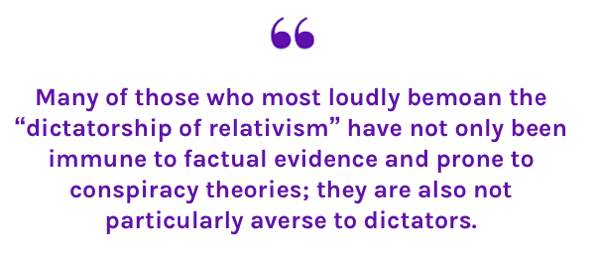

Sam Rocha, In America Magazine
Well, this seems backwards. Hopefully Janelle Shane will have a delightful and silly riposte.
Huh. My age group (45+) has about 25% more deaths this year - roughly the same excess % as for 85+. Just based on eyeball and spot-check, but I’m surprised - I expected to have much lower % increase than 85+. CDC chart
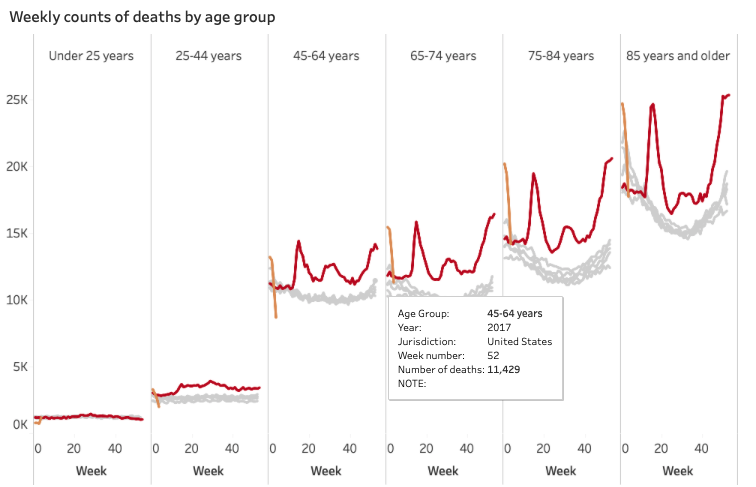
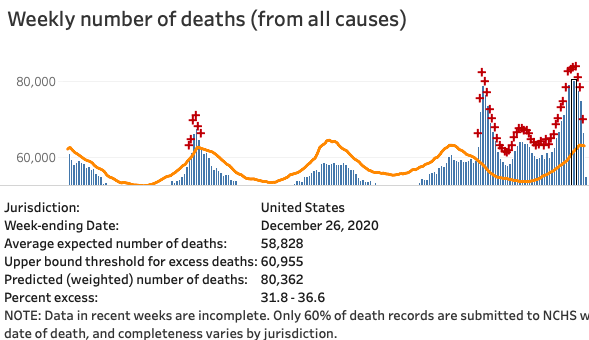
CDC total deaths snapshot: December weekly #s gained about 4,500 vs. two weeks ago: there are now 4 weeks right near 80K, slightly above the highest April week.
That’s bad. But still hard to square with covidtracking deaths being 50% higher than in April.
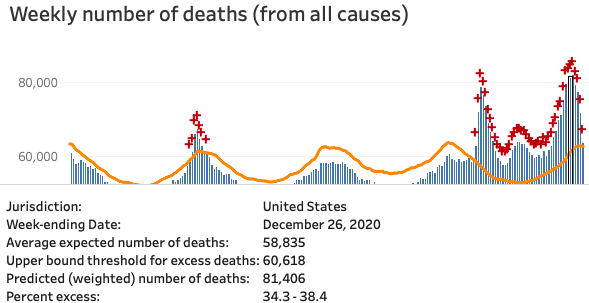
Week of 26-Dec is now at 81,406, up by ~1K. The week of 2-Jan is higher now, above 82K, gaining 1-2K.
 #### Update 23-May
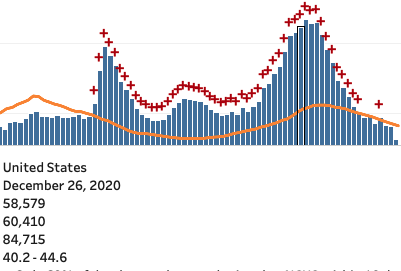
December totals are now about +26K versus April, or about +6,500/week. That’s pretty much all the discrepancy I was concerned to explain.
That further supports the live CovidTracking numbers from last autumn.
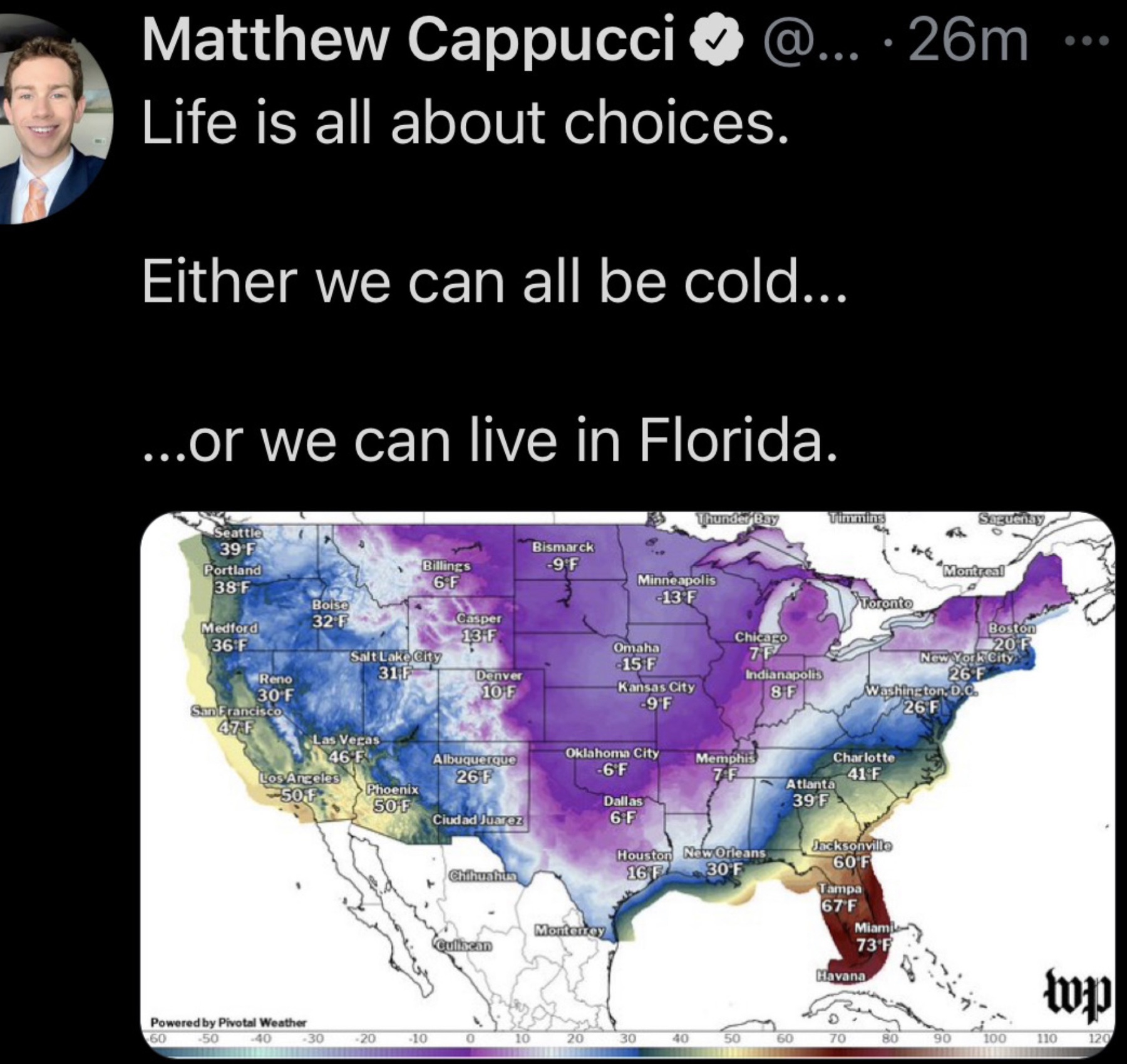
“Either we can all be cold… or we can live in Florida.”
The thing I read today was Yudkowsky on r/WallStreetBets - I did not know that.